Is AI Replacing Traders? Why Human Trading Skills Are More Valuable Than Ever in 2026
Trading Discipline & Methods | By Simon Ree | 1 June 2026
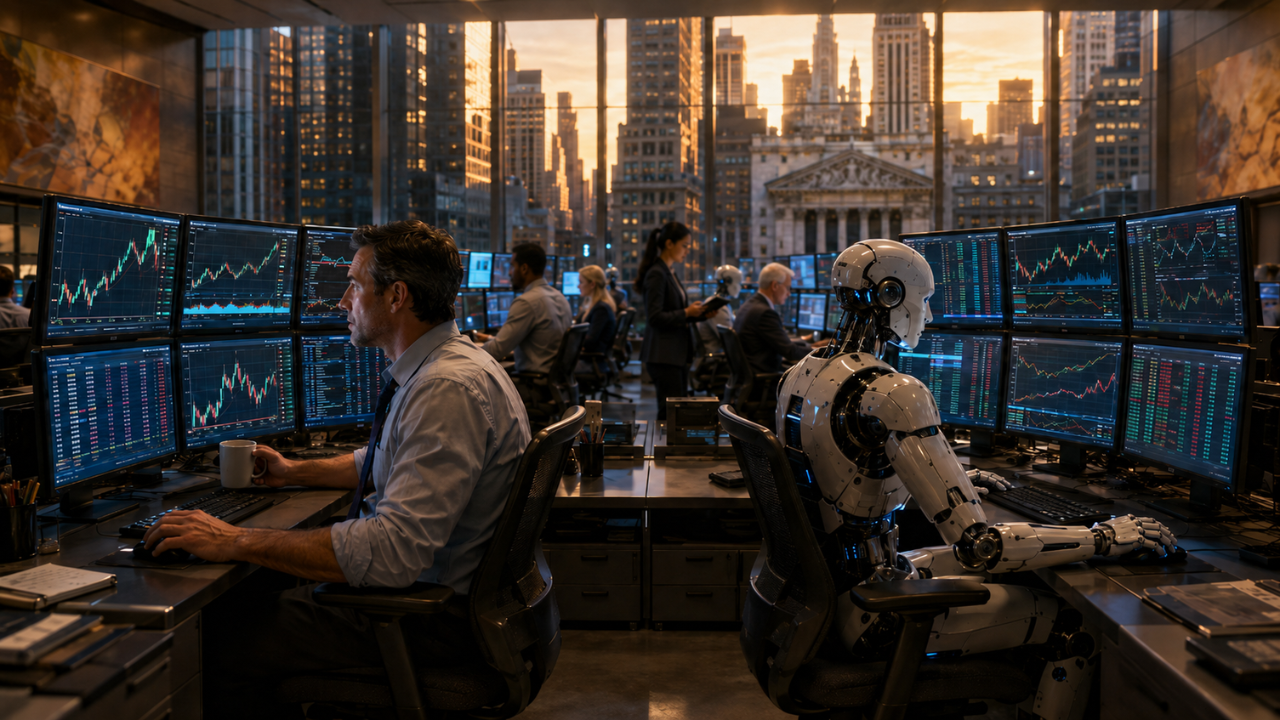
Most people think AI is finally about to retire the human trader. Three decades in financial markets tells me a different story.
In April 2025, a single policy announcement clipped 11% off the S&P 500 in two sessions. The algorithmic models did exactly what they were trained to do. Same backtested signals. Same level of confidence. Same setups that had worked beautifully in the world that just ceased to exist.
The environment had changed. The models hadn’t noticed.
That isn’t a glitch. It’s a confession. And it’s one the algorithmic trading industry has been making, quietly, for as long as it has existed.
I’ve spent over three decades in financial markets. Goldman Sachs in Australia, where I founded the Markets Desk for Australasia. Citibank in Singapore, working with billionaires and hedge funds. Then full-time as a trader and educator. I’ve watched every wave of technology get sold as the thing that would finally retire human judgment.
Some waves delivered exactly what they promised. Algos absolutely replaced the human market maker. The NYSE floor specialist is extinct. Citadel Securities, Virtu and Jane Street now do that job better than any human ever could. The mechanical, microstructure, raw-speed-based function was automatable, so it got automated. That part of the story is settled.
But notice what got replaced and what didn’t. Liquidity provision, quoting bids and offers, capturing spread, managing inventory in nanoseconds, is a speed game. The machines won it cleanly.
Directional risk-taking under genuine uncertainty, reading regime shifts, sizing into asymmetric setups, deciding when not to trade, is a judgment game. Three decades and several generations of technology later, that one is still distinctly human.
AI is now being sold as the thing that retires the rest. The judgment function. The discretionary trader. The active investor.
It won’t. And if you understand why, 2026 might be one of the better times in a generation to develop genuine trading skills.
What AI Can Actually Do (Credit Where It’s Due)
Dismissing AI outright is foolish.
AI tools can scan thousands of tickers in seconds. They can flag technical patterns the human eye would miss. They process earnings transcripts faster than any analyst, execute orders at microsecond speeds, draft watchlists in the time it takes you to pour a coffee. High-frequency firms have run algorithmic systems for decades, and those systems do exactly what they were built to do.
Retail-facing tools have matured too. In 2026, you can find platforms that generate signals, suggest options strategies, and run scenario analyses that would have been the envy of an institutional desk in 2006. That’s genuine utility. I use and have built tools like that myself.
There’s a meaningful difference between a useful tool and a replacement for judgment. That gap is where this entire question lives.
Bruce Lee said it cleanest. "Absorb what is useful, discard what is not, add what is uniquely your own." AI tools sit firmly in the first bucket. They don’t sit in the second.
Steelmanning the AI Bull Case
Before I make the counter-argument, I want to give the AI camp its strongest shot.
It goes something like this. AI processes more data than any human ever could. It strips emotion out of the equation entirely. It backtests with statistical rigour humans can’t match. It executes without hesitation, fatigue or recency bias. As models scale and training data deepens, the edge only grows. Retail traders who refuse to use AI will be left behind, the way buy-and-hold investors who refused to read charts got left behind in the 90s.
It’s coherent. On paper it sounds inevitable. And it happens to be wrong about the part that actually matters.
Where AI Keeps Getting Humbled
Most people think AI signals fail because they’re poorly built. But the good ones fail too. And the reasons have nothing to do with code quality.
Edge Is Not Prediction
Edge in markets is not “I knew it was going up.” Edge is the math underneath your process. How often you win versus how often you lose. How big your typical winner is compared to your typical loser. How disciplined you are about the size of each trade. Get those three numbers pointing the right way, run them across a few hundred trades, and the result is positive over time. That’s the whole game.
A proven probabilistic system makes that math explicit. You know your hit rate. You know your average winner versus your average loser. You know your worst expected drawdown. You know what to do when the bad streak shows up, because you’ve already mathematically planned for it.
Most “AI signals” don’t disclose any of that. You get a directional call. You don’t get the structure underneath. You can’t compound what you can’t measure, and you can’t survive what you haven’t stress-tested.
Here’s a sentence I’d tattoo on every new trader’s forearm if I could. A trader with good risk management will still be profitable even with a random, 50/50 coin-flip entry system.
Read it twice. The entry isn’t the edge. The structure around the entry is.
When the Market Changes, the Model Doesn’t Notice
This is the technical heart of the matter.
AI models are trained on data from the past. They learn the rules of a game that has already been played. The trouble is that markets keep changing the game. A trending market behaves nothing like a range-bound one. A calm market behaves nothing like a panicked one. An inflationary backdrop behaves nothing like a deflationary one. Each one rewards a different style of behaviour.
When the environment shifts, the model doesn’t notice. It keeps firing signals with the same confidence level that worked in the world it was trained on. That’s how algorithmic funds blow up. Not because the models were poorly built. Because they encountered territory their training hadn’t prepared them for.
History is littered with the corpses of “infallible” systems. Long-Term Capital Management in 1998. A whole wave of quant funds in 2007. The flash crash of 2010. The volatility blow-ups of 2018 and 2020. Same story every time. A smart model, run by smart people, walking confidently off a cliff it never saw coming.
A trained human, holding a proven system, can step back and ask a single question. “Does this setup even make sense given what the market is doing right now?” That question has saved more careers than any signal ever generated.
Crowded Trades and Goodhart’s Law
There’s a law worth remembering. When a measure becomes a target, it ceases to be a good measure.
When an AI signal starts working publicly, money piles in. Everyone takes the same trade at the same time. The edge gets squeezed out. By the time you’re seeing it on an Instagram ad, the edge is already gone.
Human judgment on top of a proven framework doesn’t suffer this fate, because the edge isn’t the signal itself. The edge is the discipline gap. The vast majority of retail traders can’t execute the same setup with consistent risk management across two hundred trades. That isn’t a software problem. It’s a behaviour problem.
The people willing to do the boring, repetitive, unglamorous work of executing a proven probabilistic system keep making money long after the latest AI signal vendor has gone dark.
The Behavioural Execution Gap
Thought experiment. Suppose AI handed you a perfect signal tomorrow morning. The market is collapsing. Your phone is going off. Your portfolio is bleeding. The signal says, “buy this symbol”.
Will you click the buy button?
Most people won’t. They’ll freeze, second-guess, override or panic-exit before the trade plays out. The signal can be perfect. The human executing it isn’t.
A trader trained on a probabilistic system has internalised the discipline to act consistently, because they understand the math. They don’t need to “know they’re on winner” to take the trade. They just need to follow the process.
AI can’t install that discipline in you. Only structured repetition can.
The Medallion Paradox
Here’s a fact worth chewing on.
The most successful systematic fund in history is Renaissance Technologies’ Medallion Fund. Roughly 39% net annualised returns over three decades. The team running it is full of mathematicians and physicists applying machine learning to markets, and they have been doing so since the 80s.
It is also closed to outside money.
The Renaissance funds outside investors could actually buy - RIEF, RIDA, RIDGE - have materially underperformed Medallion. In some recent years, they’ve materially underperformed the broader market.
Read that twice.
If pure AI signals were the universal solution, the world’s best AI-driven shop would sell them to you. They don’t. The real edge is human researchers iterating with judgment, deployed at a scale that arbitrages itself out the moment it gets shared more widely.
The retail “AI signals” sold on social media for $197/month have no comparable track record. Most never disclose one. That isn’t a coincidence. It’s the structure of the market.
Risk Management Is a Judgment Call, Not a Formula
Risk management is the most important variable in this entire equation. It’s also the one AI handles worst.
How much of your account goes into a single trade depends on your conviction, your context, the volatility regime, your recent track record, what’s happening with the rest of your portfolio, and how the broader environment is behaving. A skilled trader weighs all of that in real time.
AI systems optimise for the risk parameters they were trained on. When the world breaks the assumptions in the training data, those parameters become dangerous. The same setup that quietly makes you a dollar in calm conditions can cost you five when the market turns hostile. A human notices the shift. The model usually doesn’t.
You are a risk manager, not a trader. Install that one idea and you’re already ahead of 95% of the field.
The Edge AI Can't Touch
The traders who perform consistently share a handful of qualities that are genuinely hard to automate.
Pattern recognition with judgment. Spotting a setup is mechanical. Deciding whether to take it given everything else happening that day is not. That second step is honed after many hours of experience. There’s no shortcut.
Emotional discipline under pressure. AI doesn’t feel fear or greed. It also can’t teach you to manage yours. The traders who last are the ones who’ve built the habits to follow process when every instinct is screaming at them to do exactly the wrong thing.
Adaptability across regimes. The best traders have a toolkit, they’re not locked into a single strategy. They know which tool fits which situation. That kind of flexible, contextual thinking is a distinctly human strength.
And the biggest one? Risk-first thinking.
Protecting capital is the foundation of every lasting career in this game. The question is never just “how much can I make?” It’s always “how much can I lose, and can I live with that?” That orientation, risk before reward, is built through structured education and real market experience. No algorithm instills it.
Who's Actually Thriving in 2026
The traders doing well right now aren’t fighting AI. They’re not blindly trusting it either. They’re using it as a tool while capitalizing on the skills AI can’t replicate.
They use scanners to surface opportunities. They use alerts to stay informed without parking themselves in front of screens all day. But they make the final call. They size the trade. They decide when to exit.
That’s exactly the model my structured options trading is built around. Identify high-probability setups using a clear framework. Manage risk with defined rules. Execute consistently. Market conditions change. The process doesn’t.
That approach works in a bull market, a bear market, and a sideways market, because it’s built on principles, not predictions. Trade setups, not opinions. That’s been my mantra for three decades. Nothing about the AI era has changed it.
Building Skills That Compound
If you’re serious about building trading skills that hold their value regardless of what AI does next, prioritize these four.
Learn options
Options give you flexibility stock-only trading doesn’t. Income in flat markets. Protection in falling ones. Defined-risk exposure in rising ones. The learning curve is shorter than most people assume, once someone strips the unnecessary complexity out of how it’s taught.
Build a risk management system first, not last
Not a vague idea. An actual framework. Position sizing rules. Pre-defined exit rules. A process for handling drawdowns without abandoning your strategy. This isn’t the exciting part. It’s the part that keeps you alive long enough for the exciting part to matter.
Focus on repeatable setups
Consistency comes from knowing a small number of setups deeply, not chasing every signal that crosses your screen. Depth beats breadth.
Commit to structured learning
Self-taught traders plateau because they’re missing foundational pieces that would make everything else click. A structured programme, especially one built around real institutional experience, compresses the curve by years.
At Tao of Trading, the entire curriculum is built around exactly this kind of structured, risk-first approach. I spent three decades inside the institutional world before designing a system for everyday people who want to trade in around 20 minutes a day, without guesswork. Programmes cover options strategies from beginner to advanced. Live coaching and pre-market alerts mean you’re not learning in a vacuum.
FAQs
Will AI eventually replace all retail traders?
Unlikely. AI excels at speed and pattern recognition inside defined parameters. Retail trading success depends on judgment, adaptability, and risk management in an environment that keep changing. Those are human strengths. The traders most at risk aren’t the ones with genuine skill. They’re the ones with no structured process.
Is options trading too complex for someone without a finance background?
No. Options have more moving parts than buying a stock, but the core concepts are learnable with the right instruction. Many of our most successful students come from non-finance backgrounds. The key is starting with a structured foundation rather than piecing things together from scattered YouTube videos.
How much time do I realistically need to trade effectively?
With the right tools and a clear process, many traders complete their full daily routine in around 20 minutes. Reviewing pre-market conditions, identifying setups, placing orders. You don’t need to watch screens all day to trade well. The traders who watch screens all day usually trade worse because of it.
What's the biggest mistake new traders make in the current market?
Skipping risk management. Most beginners focus entirely on finding winning trades and ignore position sizing, stop-loss rules, and how to handle drawdowns. That gap is what ends most trading accounts before they ever have a real chance to grow. I’ve watched it play out the same way for three decades. AI hasn’t changed that pattern one bit.
Does AI make technical analysis obsolete?
No. AI tools use technical analysis as their input. Understanding why certain patterns matter, what they signal about market psychology, and how to interpret them in context is still a human skill. AI can flag a pattern. It can’t tell you whether that pattern makes sense given everything else happening in the market that day. Be careful of what looks obvious.
Can I learn to trade while working a full-time job?
Yes, and many people do. The key is a system designed around your schedule rather than one that demands constant attention. Options strategies focused on swing trades and income generation are particularly well-suited to part-time execution.
Is now a good time to start learning to trade, given market uncertainty?
Every market environment, including uncertain ones, contains opportunities if you have the right framework. Traders who build skills during volatile periods often develop stronger discipline than those who only learn in calm conditions. Starting now, with proper risk management in place, is better than waiting for a "perfect" market that never quite arrives.
Market Rewards Skilled Humans More Than Ever
Most people think AI has made trading harder. What actually happened is AI made it noisier. The two aren’t the same.
Your ability to read context, manage risk, and execute a consistent process is not getting automated away. It compounds. Every setup you learn to recognise, every trade you analyse, every time you follow your rules when it’s uncomfortable, that builds something durable.
I’ve always thought of the market as a river of moving money. We’re not here to dam it, control it, or predict where it’s headed. We’re here to dip our hand in, take a small scoop, and let the river keep flowing.
Not losing money is the game. Survival is the gateway to freedom. That was true before algorithms existed. It’s true now that half the market is run by machines. It will still be true when the next “AI is going to replace everything” wave breaks.
The humans who understand that keep showing up year after year. Everyone else cycles through their account.
If you want to build that kind of skill set inside a structured, proven framework, Tao of Trading is built for it. Get started at https://www.taooftrading.com/
Further Reading
- Fooled by Randomness and The Black Swan, by Nassim Taleb. The definitive case against confident models in non-stationary environments.
- The Man Who Solved the Market, by Gregory Zuckerman. The inside story of Renaissance Technologies and why even the best quant shop closed its doors to outside capital.
-
Trading in the Zone, by Mark Douglas. Why probabilistic thinking, not prediction, is the foundation of consistent trading.
Reminiscences of a Stock Operator, Edwin Lefèvre. Still the most accurate description of market psychology ever written, a century after publication. - The Tao of Trading, by Simon Ree. Built around the structured, risk-first system referenced above.
Suppose AI handed you a perfect signal tomorrow morning. The market is collapsing. Your phone is going off. Your portfolio is bleeding. The signal says, “buy this symbol”. Will you click the buy button?